


To read our full disclaimer, click here.

Ted Williams had a theory. Don’t swing at every pitch.
Divide the strike zone into 77 squares, each the size of a baseball. Wait for the pitch in your sweet spot.
Then crush it.
That’s how he hit .406.
Investing works the same way.
The market throws pitches at us every single day. Most of them are garbage. A few are decent. And once in a while - maybe once or twice a year if you’re paying attention - a fat pitch floats right down the middle.
The problem? Most investors swing at everything.
The Fat Pitch Rule
Here’s what I believe, and it runs through every position in Schwar Capital:
You don’t get rich by being right about a lot of things. You get rich by being right about a few things - and betting big when you are.
Buffett has said this a hundred different ways.
Munger put it more bluntly:
“The wise ones bet heavily when the world offers them that opportunity. They bet big when they have the odds. And the rest of the time, they don’t. It’s just that simple.”
That’s the game.
So when I find a business I deeply understand, with a runway I can see, a management team I trust, and a price that doesn’t require heroic assumptions - I don’t buy 2%.
I back the truck up.
Enter Ashtead Technology
Ashtead Technology is now 30% of our portfolio.
And it’s up ~65% year-to-date.
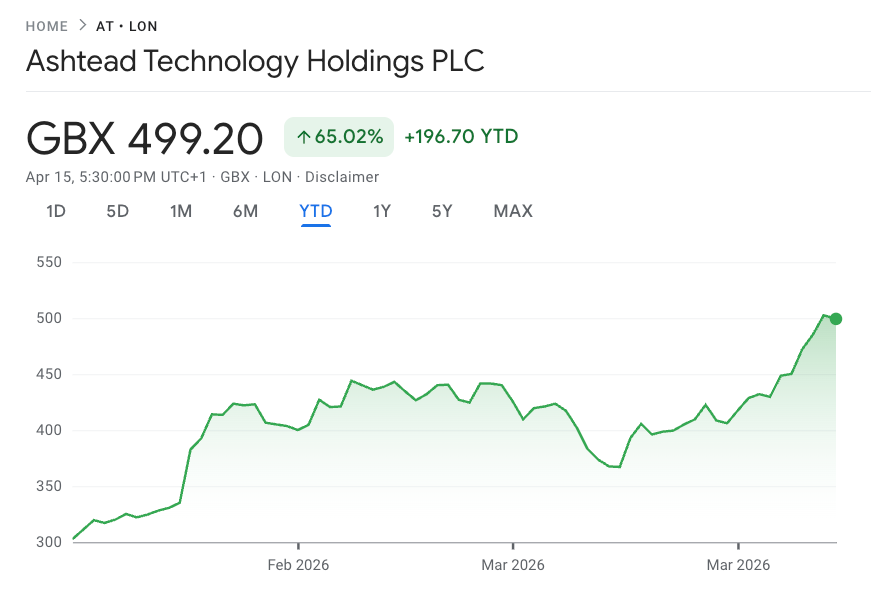
People ask me constantly: “Aren’t you going to trim? Lock in some gains? Rebalance?”
No.
Here’s why:
The thesis hasn’t broken. It’s strengthening. Offshore rental day rates are still climbing. The acquisitions (Seatronics, ACE Winches, Hiretech) are integrating better than I modelled. The subsea rental market is structurally short on kit, and Ashtead owns the fleet. They’ve built something that is very hard to replicate - and the market, in my view, still isn’t pricing it as the cash-compounding machine it is.

When a winner is winning, the worst thing you can do is interrupt the compounding.
Why Trimming Winners Is a Trap
This is the part most investors get backwards.
We’re told to “rebalance.” To “take profits.” To “never let one position get too big.” That advice is perfect - if your goal is to match the index.
If your goal is to beat it, you have to do the opposite.
The whole point of concentration investing is that your best ideas become more of your portfolio over time. That’s the mechanism. That’s the math. If I’d trimmed every position in Schwar Capital back to 5% every time it ran, I’d have a much smoother equity curve - and a much smaller one.
Winners win. Let them.
The risk isn’t that a great business gets too big in your book. The risk is that you find a great business, size it too small, and then sell it too early.
How I Play It
Look - this is what I do. It’s not for everyone, and it’s definitely not advice.
Running 30% in a single name will make plenty of people lose sleep.
Fair enough. Concentration cuts both ways, and if the thesis breaks on a position this size, it hurts.
I know that. I accept it. That’s the trade I’ve chosen to make.
But the framework, for me, is simple:
Wait for the fat pitch.
When it comes, swing hard.
When you’re right, don’t flinch.
That’s how I invest.
Find businesses I understand well enough to size up. Size them up when the price is right. Then hold on - through the noise, the volatility, and the well-meaning advice from people who think a 30% position is reckless.
For me, a 30% position in a business I’ve studied for years isn’t reckless. A 2% position in a business I barely know is.
But that’s me. Your portfolio is yours. Your risk tolerance is yours. Your circle of competence is yours.
Do the work, find your fat pitches, and size them in a way you can live with - in good years and bad.
Ashtead is one pitch. It’s the biggest one in the book right now, but it’s not the only one. The rest of the portfolio is built on the same principle - a handful of businesses I know cold, sized with conviction, held for the long arc.
If you want to see the full lineup - what’s in there, at what weight, and why - the entire portfolio is laid out here:

Same philosophy. Different pitches.
Thanks for reading,
Dom
Schwar Capital
Disclaimer: The content provided in this newsletter is for informational purposes only and does not constitute financial, investment, or other professional advice. The opinions expressed here are those of the author and do not necessarily reflect the views of Schwar Capital. Investing involves risk, including the possible loss of principal. Past performance is not indicative of future results. The author may or may not hold positions in the stocks or other financial instruments mentioned. Always do your own research or consult with a qualified financial advisor before making any investment decisions. You can see our full disclaimer here.
I'm interested in what you think about the equipment on the balance sheet of GBP200m which management commented would cost a competitor GBP300-GBP350m to buy (compared to GBP390m market cap). Does this factor into your comfort in having such a large position?
Totally agree with your thinking. I made most of my money with a few great trades in which I had taken a significant position in relation to my overall portfolio size (SHOP from 2017-2020 (8x), SMCI a few years ago (10-bagger) and STRL more recently (6x). To me, investing is not about being right all the time, it is about being right when it matters the most (i.e., when you have enough conviction to take a significant position).